Low-carbon liquid fuels for Australia’s fuel security
Australia has an opportunity to develop a distributed low-carbon liquid fuel industry that complements existing energy infrastructure, supports agriculture and strengthens national fuel security. Our technology is one potential platform that could contribute.
Heavy dependence on imported fuel
Australia remains heavily dependent on imported crude oil and refined petroleum products. That exposes the nation to:
- Supply chain disruptions
- Geopolitical instability
- Increasing fuel prices
- Carbon emissions
- Limited domestic refining capacity
The feedstock is already here
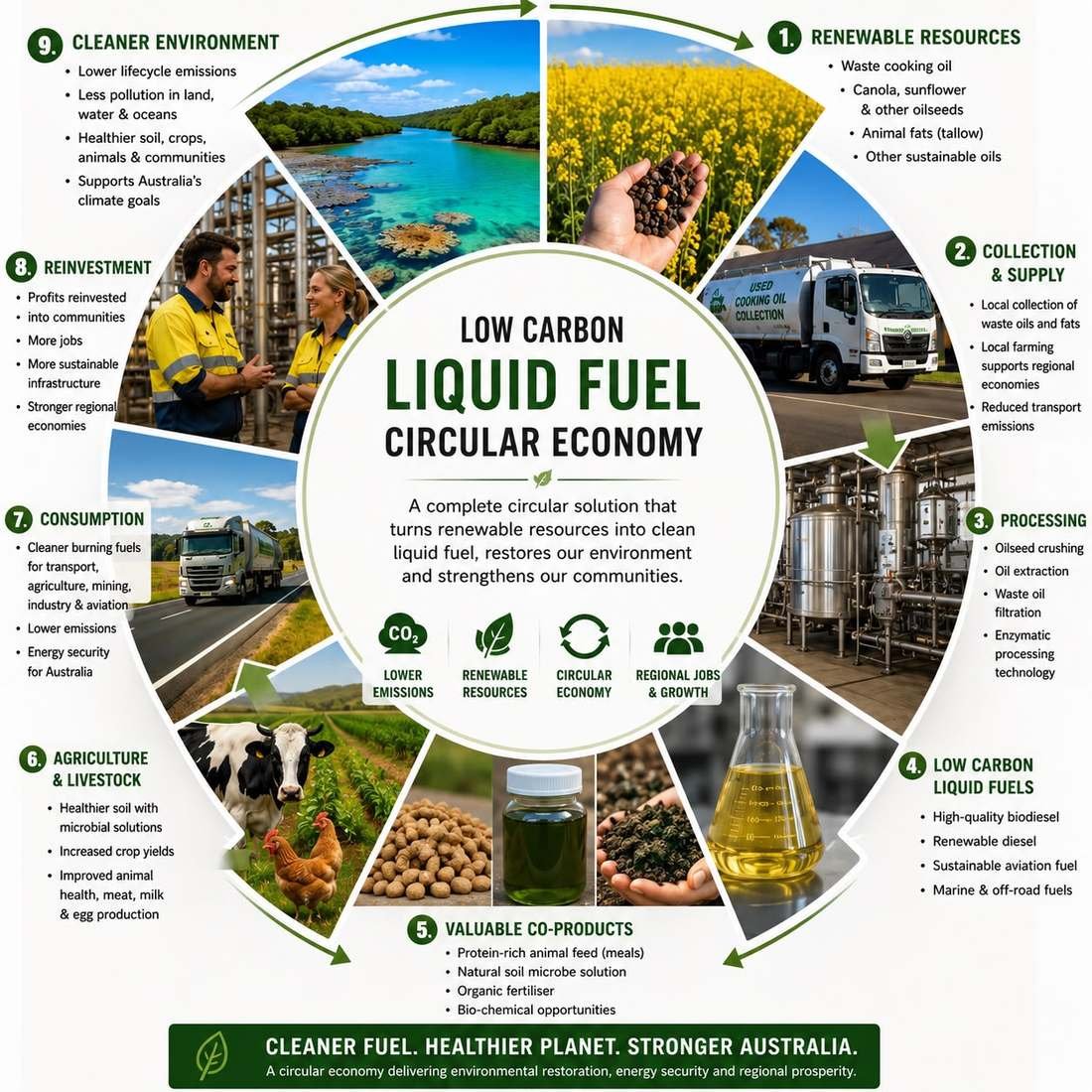
Australia already has the resources to make renewable liquid fuels from:
- Waste cooking oil
- Canola
- Sunflower
- Other renewable feedstocks
This creates a circular economy while improving national fuel resilience.
A shorter, local supply chain
Petroleum needs exploration, drilling, crude transport, centralised refining and long supply chains. Canola-based renewable fuel relies on agriculture, local feedstocks and regional processing.
| Stage | Petroleum | Renewable liquid fuel |
|---|---|---|
| 1 | Exploration | Agriculture |
| 2 | Drilling | Crop production |
| 3 | Crude transport | Local feedstock collection |
| 4 | Refining | Renewable processing |
| 5 | Long supply chain | Regional production |
| 6 | Imported crude | Australian feedstocks |
Renewable fuels keep more of the economic activity in Australia rather than relying on imported crude oil.
Petroleum and renewable liquid fuel
| Criteria | Petroleum | Renewable liquid fuel |
|---|---|---|
| Feedstock | Imported crude oil | Australian-grown crops and waste oils |
| Supply chain | Global | Local |
| Regional jobs | Limited | High potential |
| Fuel security | Import dependent | Domestic production |
| Scalability | Large central refineries | Distributed modular plants |
Central refineries or distributed plants
Petroleum
- A typical new refinery
- Multi-billion dollar investment
- Long approval process
- High construction risk
- Centralised infrastructure
- Reliant on imported crude
Renewable liquid fuel
- Distributed manufacturing plants
- Lower capital investment, depending on scale
- Faster deployment
- Regional manufacturing
- Australian-grown feedstocks
- Modular expansion
Multiple regional plants can together achieve substantial production while strengthening supply chain resilience.
What a local industry could deliver
Potential economic benefits
- Regional employment
- Increased farm income
- New manufacturing industries
- Reduced imports
- Circular economy
- Export opportunities
Potential environmental benefits
- Reduced lifecycle greenhouse gas emissions
- Productive use of waste cooking oil
- Reduced landfill
- Carbon credit opportunities
- Improved sustainability outcomes
Potential strategic benefits
- Fuel security
- Disaster resilience
- Defence supply resilience
- Regional economic development
- Agricultural diversification
Further reading
Public sources on Australian fuel security and renewable feedstocks include Australian Government fuel security reports, International Energy Agency (IEA) fuel security reports, Australian Energy Statistics, ABARES, CSIRO and the Australian Renewable Energy Agency (ARENA).
Part of the solution
See how the plants work, or talk to us about regional production.